

Introduction
Have you ever wondered how the fresh milk we buy from local supermarkets safely reaches our tables without causing illness? In the past, consuming raw milk straight from farms frequently exposed populations to harmful pathogen microorganisms, leading to widespread foodborne illnesses and severe health complications. This critical vulnerability prompted scientists and public health advocates to develop a reliable thermal method that guarantees food safety while protecting public health on a mass scale.
Modern consumers often worry about how long milk stays fresh, whether the heating process strips away vital vitamins, and what exact steps producers take before packaging. This innovative technique stands as one of the most significant revolutions in food science history. While widely known for processing milk, similar thermal treatments are routinely applied to fruit juices, cider, and liquid eggs to extend shelf life and eliminate dangerous microbes.
This comprehensive guide explores the fundamentals of thermal treatment, its historical origins, its impact on human nutrition, and its everyday applications in the dairy industry. Understanding the delicate balance between preserving milk’s natural goodness and ensuring absolute safety is essential for every conscious consumer. Let us dive deep into the fascinating science behind this everyday process.
Overview of Milk Processing Methods
The Historical Breakthrough of Louis Pasteur
During his extensive scientific career, French chemist Louis Pasteur investigated why beverages like wine and beer spoiled so easily during storage and transport. His rigorous experiments in the nineteenth century revealed that microscopic organisms were responsible for fermentation and spoilage, leading him to develop a specialized heating technique. Pasteur successfully demonstrated that briefly heating liquids to a specific temperature and then rapidly cooling them would destroy harmful microbes without ruining the liquid’s fundamental properties.
This groundbreaking discovery revolutionized the global dairy industry and played a monumental role in preventing widespread milk-borne diseases such as tuberculosis, diphtheria, and typhoid fever. What started as a laboratory experiment transformed into an industrial standard that has saved countless human lives over the decades. Modern industrial plants now utilize advanced automated systems to execute Pasteur’s core principles with incredible precision and consistency.
Looking back through a historical lens, this invention represents far more than just a chemical milestone; it remains a cornerstone of modern public health infrastructure. Making safe drinking milk accessible to urban populations dramatically reduced infant mortality rates and increased average life expectancy. Today, this legacy continues to form the foundational curriculum of food engineering and microbiology programs worldwide.
The Scientific Mechanism Behind Thermal Treatment
Microorganisms present in raw milk exhibit varying degrees of heat resistance, which dictates the strict parameters required during processing. The applied thermal energy targets the cell walls, structural proteins, and vital metabolic enzymes of pathogenic bacteria, rendering them completely inactive. Meanwhile, essential nutrients such as calcium, phosphorus, and primary proteins remain largely unaffected by the controlled temperature levels.
The core process relies on rapidly elevating the temperature of the liquid to a predetermined threshold and maintaining it for a precisely calculated duration. Immediately following this heating phase, the liquid passes through plate heat exchangers or chilled liquid channels to drop the temperature instantly. This thermal shock prevents any surviving bacterial spores from germinating and ensures the product remains microbiologically safe.
From a bacteriological perspective, this process differs fundamentally from complete sterilization, which eliminates every living organism present. By targeting only disease-causing pathogens and spoilage agents, the method preserves the natural flavor profile and nutritional integrity of the dairy. This gives it a massive advantage over traditional home boiling, which often overheats and degrades the milk structure.
Impact on Nutritional Value and Essential Vitamins
A common misconception among health-conscious consumers is that industrial heating destroys all the nutritional value found in fresh dairy products. Nutritional studies consistently show that macronutrients—including proteins, fats, and carbohydrates—remain stable and bioavailable after the process. The core structural integrity of milk as a nutrient-dense food source is successfully maintained throughout the treatment cycle.
Some heat-sensitive vitamins, particularly vitamin C and certain B-complex vitamins, experience minor reductions ranging from ten to twenty percent. However, milk is not considered a primary dietary source of vitamin C, meaning this minor loss has a negligible impact on overall daily nutrition. The reduction in water-soluble vitamins is balanced out by the immense safety benefits of removing dangerous pathogens that could cause severe illness.
Furthermore, mineral content such as calcium and magnesium remains entirely intact because these elements possess high thermal stability. The human body absorbs calcium from treated dairy just as efficiently as it does from raw alternatives. Consequently, consumers enjoy all the skeletal and metabolic benefits of dairy without risking exposure to harmful bacteria like Listeria, Salmonella, or E. coli.
Industrial Applications and Modern Technology
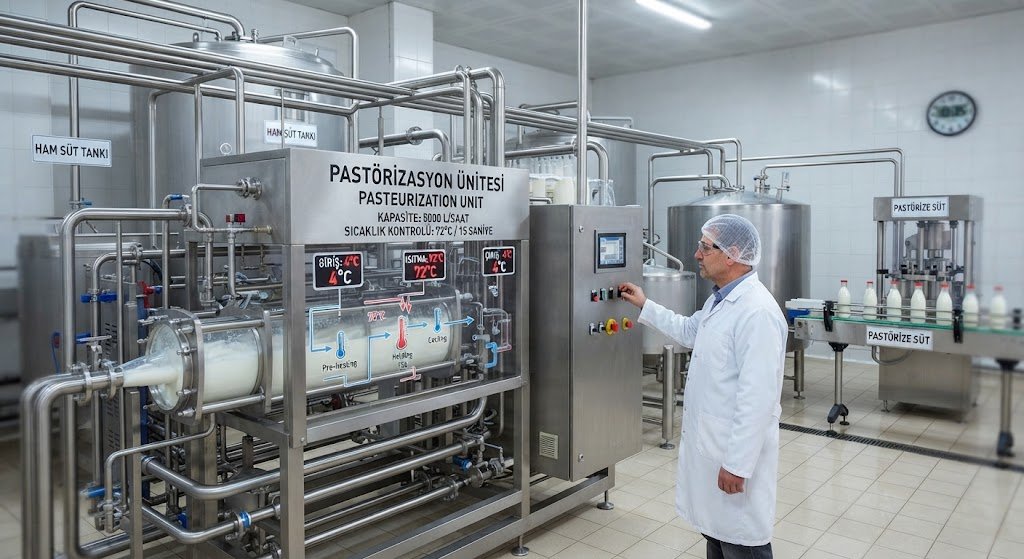
Modern dairy processing facilities utilize highly sophisticated machinery to handle massive volumes of milk with absolute sanitary precision. Automated plate heat exchangers circulate milk in thin layers between stainless steel plates, ensuring every single drop receives uniform heat exposure. Digital sensors monitor temperatures continuously, automatically diverting any fluid that fails to meet exact safety thresholds.
Quality control laboratories test samples at every stage of the production cycle to verify microbiological safety and chemical composition. Once the heating and cooling cycles finish, the milk is routed directly to automated bottling and packaging lines in sterile environments. This hermetic sealing prevents post-processing contamination from ambient air or human handling during transport to retail stores.
The integration of advanced technologies has also reduced energy consumption and water waste within modern dairy plants. Heat recovery systems capture thermal energy from outgoing hot milk to pre-heat incoming raw milk, optimizing efficiency. These engineering advancements allow large-scale producers to deliver safe, affordable dairy products to millions of households daily.
Consumer Health Protection and Disease Prevention
The implementation of mandatory milk safety regulations represents one of the greatest achievements in modern preventative medicine. Before widespread adoption, raw dairy consumption was a primary vector for transmitting zoonotic diseases from livestock to humans. Outbreaks of brucellosis and Q-fever were common occurrences that plagued communities before regulatory standards were established worldwide.
Public health agencies emphasize that pregnant women, infants, the elderly, and individuals with compromised immune systems face extreme risks from raw dairy. Pathogenic bacteria can multiply rapidly in untreated matrices, turning a nutritious food product into a severe health hazard. Controlled thermal processing acts as an invisible shield, neutralizing these microscopic threats before the product ever reaches store shelves.
Beyond individual health protection, these stringent processing standards protect entire agricultural economies from devastating supply chain disruptions. By ensuring consistent product safety and consumer trust, the dairy sector maintains steady market demand. Consumers can purchase their favorite dairy items with complete confidence, knowing stringent protocols safeguard their wellbeing.
Economic and Environmental Impact of Dairy Processing
The dairy supply chain operates under tight economic margins, requiring efficient processing methods to minimize waste and maximize shelf life. Untreated raw milk spoils within hours at room temperature, making large-scale distribution economically unfeasible. By extending the usable window of dairy products, thermal treatment allows producers to transport goods across vast geographic regions without losing inventory to spoilage.
Reducing food waste yields massive environmental benefits by lowering the carbon footprint associated with livestock production and transportation logistics. When dairy products remain fresh longer in household refrigerators, consumer-level waste drops significantly. This efficiency optimizes resource utilization across farms, processing plants, distribution networks, and retail outlets.
Moreover, the standardization of dairy processing supports fair pricing and consistent product availability for global markets. Cooperatives and independent farmers rely on predictable processing pipelines to market their daily yields sustainably. Ultimately, this foundational technique bridges the gap between rural agricultural production and urban consumer demand efficiently.
Frequently Asked Questions
-
Does the process remove all bacteria from milk? It eliminates nearly all pathogenic and spoilage bacteria, but it is not a complete sterilization process. Some harmless heat-tolerant bacteria may survive, which is why pasteurized milk still requires refrigeration.
-
Can I safely pasteurize raw milk at home? While heating raw milk on a stove top can kill some bacteria, home methods lack precise temperature and timing controls. This makes it easy to overheat the milk, ruining its taste and nutritional profile.
-
How long does milk stay fresh after treatment? Standard refrigerated milk typically remains fresh for one to two weeks if kept at proper cold temperatures. Ultra-high temperature variants can remain unopened on pantry shelves for several months.
-
Does pasteurized milk cause lactose intolerance? No, the treatment does not alter the lactose sugar content of milk. Individuals with lactose intolerance experience symptoms due to a lack of the lactase enzyme, regardless of whether the milk has been heated.
-
Is organic milk processed differently than conventional milk? The fundamental thermal processing methods used for organic and conventional milk are identical. The primary difference lies in how the dairy cows are raised and fed on the farm.
Conclusion
Ensuring the safety and nutritional integrity of our daily dairy supply relies on the precise application of controlled thermal processing. Throughout this exploration, we have examined how historical scientific breakthroughs transformed public health and made milk consumption safe for billions worldwide. By neutralizing dangerous pathogens while preserving essential minerals and proteins, this technique bridges the gap between agricultural production and consumer safety.
The evolution of modern processing technology continues to enhance efficiency, reduce food waste, and protect vulnerable populations from dangerous infections. Far from diminishing the value of fresh milk, thermal treatment safeguards its nutritional benefits and extends its availability across global markets. This invisible guardian of food safety remains an indispensable element of our daily nutritional security.
As consumer awareness grows and food standards continue to advance, understanding the science behind our food empowers us to make healthier choices. Recognizing the value of rigorous quality controls helps us appreciate the complex systems working behind the scenes to deliver safe, wholesome products to our tables every single day.